
Posterior Subcapsular Cataract
This type forms just under the back capsule of the lens, directly in the visual axis — so glare in bright light and reading vision are usually affected first, often more than distance vision.
- Reading and glare affected early
- Tends to change faster than other types
- Treated with routine cataract surgery
Camden (Orchard)Joo ChiatClementiBedokToa Payoh

What a posterior subcapsular cataract is
A posterior subcapsular cataract is a cloudy patch that forms at the back of the eye’s natural lens, just beneath the thin capsule holding it in place. It sits directly in the visual axis, the path light takes to the retina, so it can blur reading and make bright light uncomfortable while distance vision still measures well on a chart.
Cataracts are named for where in the lens the clouding starts, and the three types behave differently enough that the distinction is worth making. Many eyes have more than one at the same time.
-
Nuclear — clouding in the centre
-
Cortical — clouding at the outer edge
-
Posterior subcapsular — clouding at the back
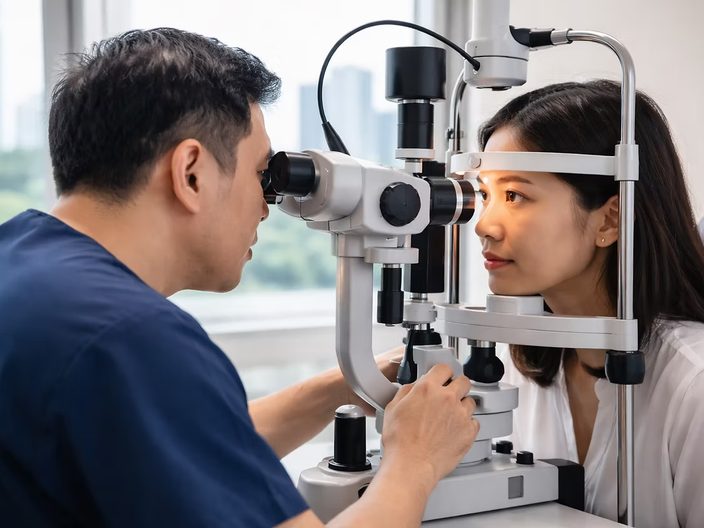
Only an examination can tell which type is present, and whether it is what is causing your symptoms. Our eye specialist clinic in Singapore examines the lens at the slit lamp with the pupil dilated, which is how a patch at the back of the lens is seen at all.


Concerned about cataracts or vision loss? Talk to our friendly staff for a same-day appointment (subject to availability).
Symptoms of a posterior subcapsular cataract
What people tend to notice first. The pattern is different from the other two types, and that difference is why it is often missed early.
- Reading harder than distance vision
- Glare and sensitivity to bright light
- Haloes around headlights at night
- New glasses that do not help for long
The pupil constricts in bright light, and again when you focus on something close. A small pupil forces all the light through the middle of the lens — straight through the patch, with no way round it. When the pupil widens in dim light, light can pass round the patch through the clearer edge of the lens. That is why the same eye often sees better in a dim room than on a sunny day, and why reading is usually the first thing to suffer.
These symptoms are not unique to a cataract. Message us on WhatsApp and we will arrange an examination.
What causes a posterior subcapsular cataract
Ageing accounts for many of them. The rest usually have an identifiable cause, and that is why this type turns up in people who are younger than the usual cataract age.
The associations most often found:
- Long-term corticosteroid treatment — a steroid-induced cataract is usually this type.
- Diabetes.
- Inflammation inside the eye, such as uveitis — often alongside the steroids used to treat it.
- Previous surgery inside the eye, particularly vitrectomy.
- An injury to the eye.
- Radiotherapy involving the head or the eye.
- Severe short-sightedness.
Corticosteroids are the association specific to this type. A 2025 review of glucocorticoid-induced cataract describes the opacities it produces as posterior subcapsular, and finds the risk rising with the cumulative dose and with the length of the course. It is not only tablets: steroid drops, injections around or into the eye, and inhaled or nasal steroids all carry the association.
Do not stop a prescribed steroid on your own. Talk to your doctor who prescribed it, or bring the prescription to your eye appointment for medical advice instead.
Several of these causes have nothing to do with age, which is why this is the type most often found in younger adults. A cataract found early is a reason to look for the cause as well as to treat the lens.
How quickly it progresses
A posterior subcapsular cataract tends to change faster than the other two types, and it is the least common of the three to develop in the first place.
From the Singapore Malay Eye Study, which re-examined Malay adults aged 40 and over six years after their first visit. Of the eyes that already had a cataract at the start, this is the share that had got worse by the end:
- Posterior subcapsular
- 40.6% had progressed within six years.
- Cortical
- 20.4% had progressed over the same period.
- Nuclear
- 5.9% had progressed over the same period.
New posterior subcapsular cataract appeared in 8.7% of eyes over those same six years — the lowest of the three. So it is at once the least common to develop and the quickest to change once it has.
How it differs from other cataracts
The three types are named for where in the lens the clouding starts.
- Nuclear
- Forms in the centre of the lens and is the one most associated with ageing. It yellows as it thickens, so colours wash out and distance vision goes first. It is usually the slowest of the three to change.
- Cortical
- Forms as spokes at the outer edge of the lens and works inwards. Glare and scattered light are the common complaints; it can be well advanced at the edges before the centre of vision is touched.
- Posterior subcapsular
- Forms as a patch at the back of the lens, under the capsule. It is often small and still causes symptoms early — not because of its size, but because it sits directly in the visual axis.
One other name is worth separating out, because it is close enough to cause confusion. Posterior capsule opacification is not a posterior subcapsular cataract. A posterior subcapsular cataract is a clouding of your own lens, before any surgery. Posterior capsule opacification is a thickening of the capsule left in place to hold the artificial lens, months or years after cataract surgery, and it is cleared with a short laser procedure in clinic rather than an operation.
How a posterior subcapsular cataract is treated
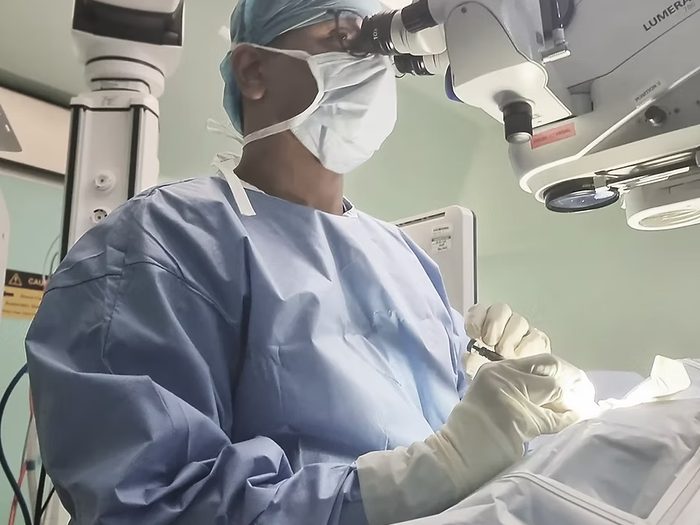
The treatment is surgery to remove the cataract, done as day surgery under local anaesthesia. No drop, tablet or eye exercise clears a cataract of any type.
What differs is the timing. This type sits directly in the visual axis, so symptoms can be limiting while a distance chart still reads well — the decision rests on what you can no longer do comfortably.
Two decisions follow, the same as for any cataract: which lens goes in, and what the surgery costs, including MediSave.
Posterior Subcapsular Cataract Treatment Cost
Cataract surgery at The Straits Eye Centre is between $5,200 and $13,000 per eye, before MediSave. The Straits Eye Centre is a MediSave-approved clinic.
| Cataract surgery | Per eye |
|---|---|
| Surgery, before MediSave | $5,200–13,000 |
| MediSave withdrawal limit | up to $2,450 |
The final range depends on the lens, whether laser assistance is used, and your insurance status. Every operation is performed by one of our senior consultant eye surgeons. See the full cost breakdown
Who performs it
A posterior subcapsular cataract is removed by the same operation as any other cataract, and all three of our senior consultant eye surgeons perform it — more than 50 years in ophthalmology between them. Talk to us for a quick appointment.
10,000+
cataract operations, between our three senior consultant eye surgeons.
-

Dr Jayant V Iyer
Senior Consultant & Medical Director
The Straits Eye CentreMBBS · GDFM · MMed (Ophth) · FRCOphth · FAMS
-

Dr Jason Lee
Senior Consultant & Medical Director
The Straits Eye CentreMBBS · BMedSc · MMed (Ophth) · FRCOphth · FAMS
-

Dr Audrey Pang
Senior Consultant Eye Surgeon, The Straits Eye Centre
Visiting Consultant, TTSH and NUHMBBChir (Cambridge) · MMed (Singapore) · FRCOphth (London) · FAMS
Common questions
What is a posterior subcapsular cataract?
It is a cataract that forms at the back of the eye’s natural lens, just beneath the thin capsule holding the lens in place. It is one of the three main types, alongside nuclear cataract in the centre of the lens and cortical cataract at its edges.
How does a posterior subcapsular cataract affect vision?
It usually affects reading and bright light before it affects distance vision. Because the clouding sits at the back of the lens, directly in the visual axis, a small opacity can cause noticeable glare and blur while a distance chart still reads reasonably well.
Why is vision worse in bright light?
Bright light makes the pupil constrict, and a small pupil forces all the light through the middle of the lens — straight through the patch, with no way round it. In dim light the pupil widens and light can pass round the patch through the clearer edge of the lens. The pupil constricts for close focus too, which is why reading is affected early.
What causes a posterior subcapsular cataract?
Ageing accounts for many. The rest are associated with long-term corticosteroid treatment, diabetes, inflammation inside the eye, previous surgery inside the eye, injury, radiotherapy involving the eye, and severe short-sightedness. An examination is what identifies which applies.
Can steroids cause a posterior subcapsular cataract?
Yes — a steroid-induced cataract is usually a posterior subcapsular one. The risk rises with the total dose and the length of the course, and applies to steroid drops and injections as well as tablets. Do not stop a prescribed steroid on your own — the doctor who prescribed it can review it.
How fast does a posterior subcapsular cataract progress?
Faster than the other two types, on average. In a six-year study of Malay adults aged 40 and over in Singapore, 40.6% of eyes that already had a posterior subcapsular cataract had progressed, against 20.4% of cortical and 5.9% of nuclear cataracts. Individual eyes vary widely.
Can a posterior subcapsular cataract be reversed?
No. No drop, tablet or eye exercise clears a cataract of any type. The clouded lens is replaced with a clear artificial one, which is the same operation used for every other cataract.
Is a posterior subcapsular cataract the same as posterior capsule opacification?
No, although the names are close. A posterior subcapsular cataract is a clouding of your own lens, before any surgery. Posterior capsule opacification is a thickening of the capsule that holds the artificial lens, months or years after cataract surgery, and is treated with a short laser procedure in clinic.
Ask about your eyes
Send us a message and we will answer. If you have been told you have a cataract at the back of the lens, or you are on long-term steroids and want your eyes checked, say so in the message.