
Cataract Lens Options
The lens is implanted for life, so it is chosen against your own eyes and your own day — not from a list.
- Monofocal, extended depth of focus, multifocal
- Toric versions correct astigmatism
- Recommended after your eyes are measured
Camden (Orchard)Joo ChiatClementiBedokToa PayohJurong
Found this helpful?


What an intraocular lens is
Cataract surgery removes the eye’s clouded natural lens, and an artificial one — an intraocular lens (IOL), also called a lens implant — is put in its place. It is implanted permanently, and which type is used decides what you will see clearly without glasses afterwards.
There are three broad types, and they differ in one thing: how many distances the lens can bring into focus at once. Everything else — the operation, the recovery, the risks — is the same whichever is chosen.
The three types
Ordered by how much of your range of vision the lens brings into focus. None of them is the best one; they are three different trades.
| Lens | Far | Arm’s length | Near |
|---|---|---|---|
| Monofocal, set for distance | Designed to focus here | Not designed for this distance | Not designed for this distance |
| Extended depth of focus | Designed to focus here | Designed to focus here | Not designed for this distance |
| Multifocal: bifocal | Designed to focus here | Not designed for this distance | Designed to focus here |
| Multifocal: trifocal | Designed to focus here | Designed to focus here | Designed to focus here |
-
Monofocal
Focused at a single distance, and that distance is a choice — far, arm’s length or near, with far the usual one. It is the lens most cataract surgery is done with, and it sits at the lower end of the fee range. See monofocal lenses
-
Extended depth of focus
Stretches one focal point into a range, so distance and arm’s-length work — a dashboard, a screen — are usually covered by the same lens. Small print generally still needs glasses. See EDOF lenses
-
Multifocal
Splits light between more than one focal point, so the lens is designed to cover both distance and near. A bifocal has two focal points and a trifocal three, adding arm’s length. It is the type most likely to reduce how often glasses are needed. See multifocal lenses
Toric lenses and astigmatism
Astigmatism blurs things at every distance, and most of it comes from the cornea curving more steeply in one direction than the other — so it is still there after a cataract is removed, unless it is corrected.
A toric version of a lens has that correction built in, which means it has to sit at a measured angle. All three types above are available as toric lenses, so it is a separate question from which type you choose.
Whether you need one is measured before surgery. See how a toric lens works
What you will still need glasses for
No lens is guaranteed to remove the need for glasses, and none should be chosen on that basis. What each type typically leaves:
- Monofocal
- Reading and most screen work. Distance is usually clear without glasses.
- Extended depth of focus
- Small print, and often prolonged reading. Distance and intermediate usually are not.
- Multifocal
- Varies. Some people use glasses rarely; others still need them for fine print or in poor light.
- Any of the three
- Astigmatism, unless it is corrected — by a toric version of the lens, or at the time of surgery.
Whichever type you have, the new prescription is not measured until the eye has settled — usually towards the end of the first six weeks. Glasses bought before that are made to a number that is still moving. See how recovery works
Monovision and blended vision
One eye can be set for distance and the other for near, and the brain learns to use whichever eye is in focus. This is monovision, and it is usually done with monofocal lenses.
Blended vision is a milder version: the second eye is set for arm’s length rather than near, so the two eyes overlap more and the difference is easier to get used to. Small print usually still needs glasses.
| Approach | Far | Arm’s length | Near |
|---|---|---|---|
| Monovision | One eye | Neither eye | The other eye |
| Blended vision | One eye | The other eye | Neither eye |
Not everyone adapts to it, and judging depth can be slightly harder. It is worth trialling with contact lenses first where that is possible.
How the choice is made
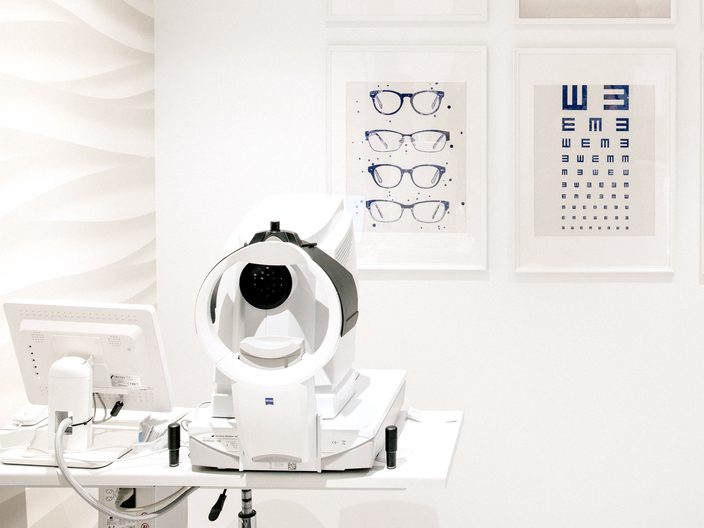
Your eye surgeon measures the length and curvature of the eye, and that decides the lens power before anything else is discussed. Several findings then rule options in or out rather than being matters of preference:
- Astigmatism
- The size of your pupil
- The state of the cornea
- Dry eye
- Any previous eye surgery
- Any disease of the retina or optic nerve
A multifocal lens reduces contrast sensitivity, because the light is divided between focal points. Where the retina or optic nerve is already limiting vision, that further reduction is harder to tolerate and the underlying disease is harder to monitor, so the type is generally not offered.
It helps to go in with questions to ask your cataract surgeon.
Cataract surgery after LASIK
Having had LASIK does not stop you having cataract surgery, but it makes the lens power harder to calculate. The laser reshaped your cornea, and the standard formulas assume one that has not been reshaped.
Surgeons use formulas designed for eyes after laser surgery, and your original LASIK records help if you still have them, so say so before your eyes are measured. Even then, the result is more likely to land slightly off target, and some people need glasses or a small further correction afterwards.
Previous laser surgery is also one of the findings that can rule a lens type in or out.
How long a lens lasts
An intraocular lens is intended to stay for life. It does not wear out, and unlike the natural lens it replaces, it does not cloud with age. What can change, years later:
- The capsule behind it
- Can cloud over months or years later and dull vision again, as cells left behind at surgery grow across it. This is posterior capsule opacification, sometimes called a secondary cataract, although the cataract has not returned and the artificial lens is unaffected. It is treated with a short laser procedure in clinic — a YAG laser — rather than with further surgery.
- Its position
- Held in place by the capsule. Rarely, years later, lens and capsule shift together — more often after an eye injury, or where the fibres holding the capsule were already weak — and the lens can then be repositioned or exchanged in a further operation.
Despite the similar name, posterior capsule opacification is not a posterior subcapsular cataract, which is a clouding of your own lens before any surgery.
Common questions
Which lens is best for cataract surgery?
There is no single best lens, and any page that names one is selling something. The right lens depends on your eyes, what you do with your vision, and what you are willing to trade. Your surgeon recommends one after measuring your eyes and asking how you spend your day.
Will I still need glasses after cataract surgery?
With a monofocal lens, yes — for reading and usually for screens. With an extended depth of focus or multifocal lens you may need them less often, but no lens is guaranteed to remove the need entirely, and none should be chosen on that promise.
Do multifocal lenses cause haloes at night?
Haloes and glare around lights at night are a recognised effect of splitting light between focal points, and they are reported more often with multifocal lenses than with the other types. They commonly settle over the first months as the brain adapts, but they do not settle for everyone. If you drive at night for a living, say so before you choose.
Can I have a different lens in each eye?
It is sometimes done — one eye set for distance and the other for near, which is called monovision. It suits some people well and others not at all, and it is usually worth trialling with contact lenses first where that is possible.
Can the lens be changed later?
An intraocular lens is intended to stay for life and exchanging one is a further operation with its own risks, so it is done only where there is a clear reason. This is why the choice is worth the time it takes before surgery rather than after.
How long does a cataract lens last?
It is intended to last for life: it does not wear out and does not cloud with age. What can dull vision again, months or years later, is the capsule behind it clouding over — cells left behind at surgery growing across it — and that is treated with a short laser procedure in clinic.
Can I have cataract surgery if I have had LASIK?
Yes. LASIK reshapes the cornea, which makes the lens power harder to calculate, so say so before your eyes are measured and bring your old records if you still have them. The result is more likely to land slightly off target and to need glasses or a small further correction afterwards.
Does a more expensive lens give better vision?
Not on its own. The three types are designed for different visual goals rather than arranged on a scale, and the one that costs more is the one doing more things at once — which is only worth paying for if those are the things you need. A monofocal lens gives sharp distance vision, and for a great many people that is the whole of what they wanted.
Does the lens change the cost of surgery?
Yes, and it is the largest single variable. A monofocal lens sits at the lower end of the $5,200 to $12,000 range and toric, extended depth of focus and multifocal lenses cost more. The cost page sets out what else moves the figure.
Talk through the lens options
Send us a message with how you use your eyes day to day, and we will arrange an examination. The lens is recommended once your eyes have been measured.