
Cortical Cataract
This type forms as wedges at the outer rim of the lens and works inwards — so glare and haloes are usually noticed first, often while a distance chart still reads well.
- Glare and haloes noticed early
- Starts away from the centre of vision
- Treated with routine cataract surgery
Camden (Orchard)Joo ChiatClementiBedokToa PayohJurong
Found this helpful?


What a cortical cataract is
A cortical cataract is a clouding of the cortex, the outer layer of the eye’s natural lens. It starts as wedges at the rim and works inwards, so light is scattered before it is blocked.
Cataracts are named for where in the lens the clouding starts, and many eyes have more than one type at once.
-
Nuclear — clouding in the centre
-
Cortical — clouding from the edge inwards
-
Posterior subcapsular — clouding at the back
An examination note may call these wedges cortical spokes, because they look like the spokes of a wheel. The term describes the pattern, not how bad it is.
Vision can still measure well on a chart while the edges are clouded. A cataract screening at our community clinics is one way to have the lens looked at.
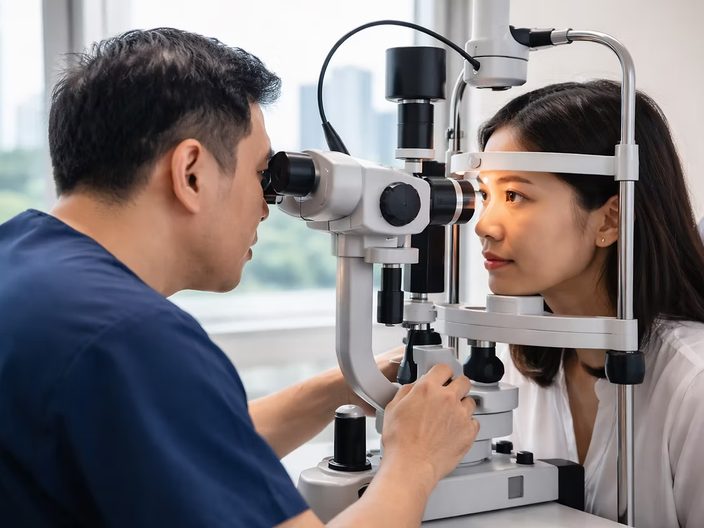


Concerned about cataracts or vision loss? Talk to our friendly staff for a same-day appointment (subject to availability).
Symptoms of a cortical cataract
Early on, bright light is the problem more than blur.
- Glare in bright sunlight
- Haloes and starbursts around headlights
- A spectacle prescription that keeps changing
Eyesight can still test well on a chart even when glare has become a problem. Only an examination by an eye specialist in Singapore can tell whether a cataract is the cause. Message us on WhatsApp and we will arrange an examination.
What causes a cortical cataract
Ageing accounts for most. Sunlight and diabetes are also linked.
- Ageing
- The cortex takes on water and its fibres separate, so the wedges form along the lines the fibres already run.
- Sunlight
- Linked to this type more than the other two, though the effect is small. In a meta-analysis of 31 studies, the odds ratio was 1.03 for cortical cataract against 1.00 for nuclear. Sunglasses that block ultraviolet light are worth wearing anyway.
- Diabetes
- Associated with cataract of every type. In a four-year study of people with type 2 diabetes, new cortical cataract appeared in 25.7% of those followed, with age the strongest factor.
Smoking is not on this list. The meta-analysis that ties smoking to nuclear cataract found no link with the cortical type.
How quickly it progresses
A cortical cataract sits between the other two types: slower to change than a posterior subcapsular cataract, faster than a nuclear one.
The Singapore Malay Eye Study re-examined Malay adults aged 40 and over after six years. Of the eyes that already had a cataract:
- Posterior subcapsular
- 40.6% had progressed within six years.
- Cortical
- 20.4% had progressed over the same period.
- Nuclear
- 5.9% had progressed over the same period.
An average describes a group, not an eye. Two people with the same finding can change at different rates. The interval between reviews is set at each examination.
How it differs from other cataracts
The three types are named for where in the lens the clouding starts.
- Nuclear
- Forms in the centre of the lens and is the one most associated with ageing. It yellows as it thickens, so colours wash out and distance vision goes first. It is usually the slowest of the three to change.
- Cortical
- Forms as spokes at the outer edge of the lens and works inwards. Glare and scattered light are the common complaints; it can be well advanced at the edges before the centre of vision is touched.
- Posterior subcapsular
- Forms as a patch at the back of the lens, under the capsule. It sits directly in the visual axis, so even a small one affects reading and vision in bright light first, often more than distance vision. It tends to be the fastest of the three to change.
How a cortical cataract is treated
The only treatment that removes it is an operation to replace the lens, done as day surgery under local anaesthesia. No drop, tablet or eye exercise clears a cataract.
While it stays at the rim it may cause little trouble and can be kept under review. The timing of surgery depends on how much glare and blur affect your daily life, such as driving at night. The next decision is which lens to choose.
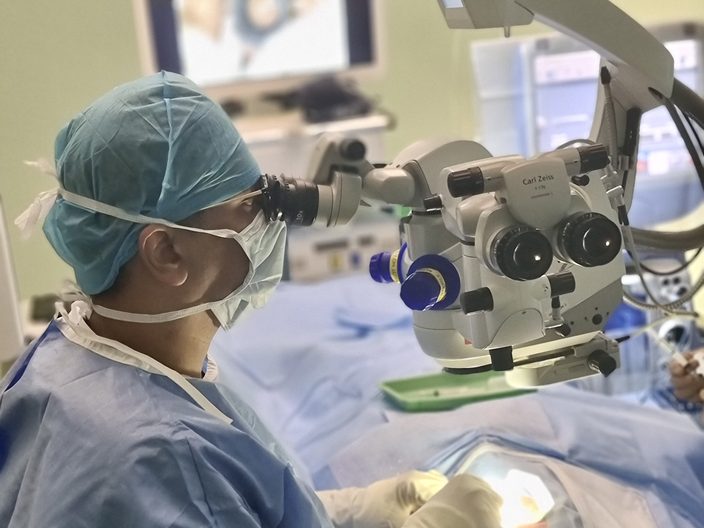
Cortical Cataract Treatment Cost
Cataract surgery at The Straits Eye Centre is between $5,200 and $12,000 per eye, before MediSave. The Straits Eye Centre is a MediSave-approved clinic.
| Service | Per eye |
|---|---|
| Cataract surgery by senior eye surgeons | $5,200–12,000 |
| MediSave withdrawal limit | up to $3,280 |
Figures are per eye at The Straits Eye Centre, before MediSave. Withdrawal limit subject to approval by the CPF Board.
The final range depends on the lens, whether laser assistance is used, and your insurance status. Every operation is performed by one of our senior consultant eye surgeons. See the full cost breakdown
Who performs it
A cortical cataract is removed by the same operation as any other cataract, and our senior consultant eye surgeons perform it — more than 60 years in ophthalmology between them. Talk to us for a quick appointment.
99%+
cataract surgery success rate at The Straits Eye Centre.
-

Dr Jayant V Iyer
Senior Consultant & Medical Director
The Straits Eye CentreMBBS · GDFM · MMed (Ophth) · FRCOphth · FAMS
-

Dr Jason Lee
Senior Consultant & Medical Director
The Straits Eye CentreMBBS · BMedSc · MMed (Ophth) · FRCOphth · FAMS
-

Dr Audrey Pang
Senior Consultant Eye Surgeon
The Straits Eye CentreMBBChir (Cambridge) · MMed (Singapore) · FRCOphth (London) · FAMS
-

Dr Laurence Lim Shen
Senior Consultant Eye Specialist and Vitreo-Retinal Surgeon
The Straits Eye CentreMBBS (S’pore) · MRCS (Edin) · FRCS (Edin) · FAMS
Common questions
What is a cortical cataract?
It is a cataract that forms in the cortex, the outer layer of the eye’s natural lens that surrounds the dense centre. It begins as wedge-shaped opacities at the rim of the lens, known as cortical spokes, and works inwards.
What does a cortical cataract do to your vision?
Its main effect is scatter rather than blur. The wedges break up light passing through the edge of the lens, so glare in sunlight and haloes around headlights are usually noticed before anything shows on a distance chart. Once the wedges reach the centre of the lens, sharpness goes too.
What are cortical spokes?
Cortical spokes are the opacities a cortical cataract forms. Seen through a slit lamp with the pupil dilated, they radiate inwards from the rim of the lens like the spokes of a wheel, which is where the name comes from. The term describes the appearance, not the severity.
Does sunlight cause cortical cataracts?
Sunlight is associated with cortical cataract more than with the other two types, but the effect measured is small. A meta-analysis of 31 studies put the pooled odds ratio at 1.03 for cortical cataract, against 1.00 for nuclear and 0.99 for posterior subcapsular. Sunglasses that block ultraviolet light are worth wearing, and for more reasons than this one.
Is cortical cataract linked to diabetes?
Diabetes is associated with cataract of every type, and cortical cataract is among them. In a four-year study of people with type 2 diabetes, new cortical cataract appeared in 25.7% of those followed. Blood sugar is managed by the doctor treating the diabetes; an eye examination is what shows whether the lens has been affected.
Does smoking cause cortical cataracts?
The evidence does not link the two. A meta-analysis of 21 studies found smoking raised the risk of nuclear cataract substantially, but found no association with cortical cataract. Smoking remains a risk for the nuclear type and for eye disease more broadly.
How quickly does a cortical cataract get worse?
More slowly than a posterior subcapsular cataract and faster than a nuclear one, on average. In a six-year study of Malay adults aged 40 and over in Singapore, 20.4% of eyes that already had a cortical cataract had progressed. Individual eyes vary widely.
Does a cortical cataract always need surgery?
Not immediately. A cortical cataract confined to the rim of the lens may cause little difficulty, and reviewing it is reasonable. Surgery is the only treatment that removes it, and the timing rests on what you can no longer do comfortably. An examination is what tells you where yours has reached.
Ask about your eyes
Send us a message and we will answer. If you have been told you have clouding at the edge of the lens, or glare and haloes have started to bother you at night, say so in the message.