Drops
One drop at bedtime. Glasses are still worn, because the drops do not correct vision.
Short-sightedness increases as a child grows, and treatment can slow it down. This page covers the three options — low-dose atropine, myopia-control spectacle lenses and ortho-K — and how the choice is made.
Camden (Orchard)Parkway East (Joo Chiat)Children
A paediatric ophthalmologist
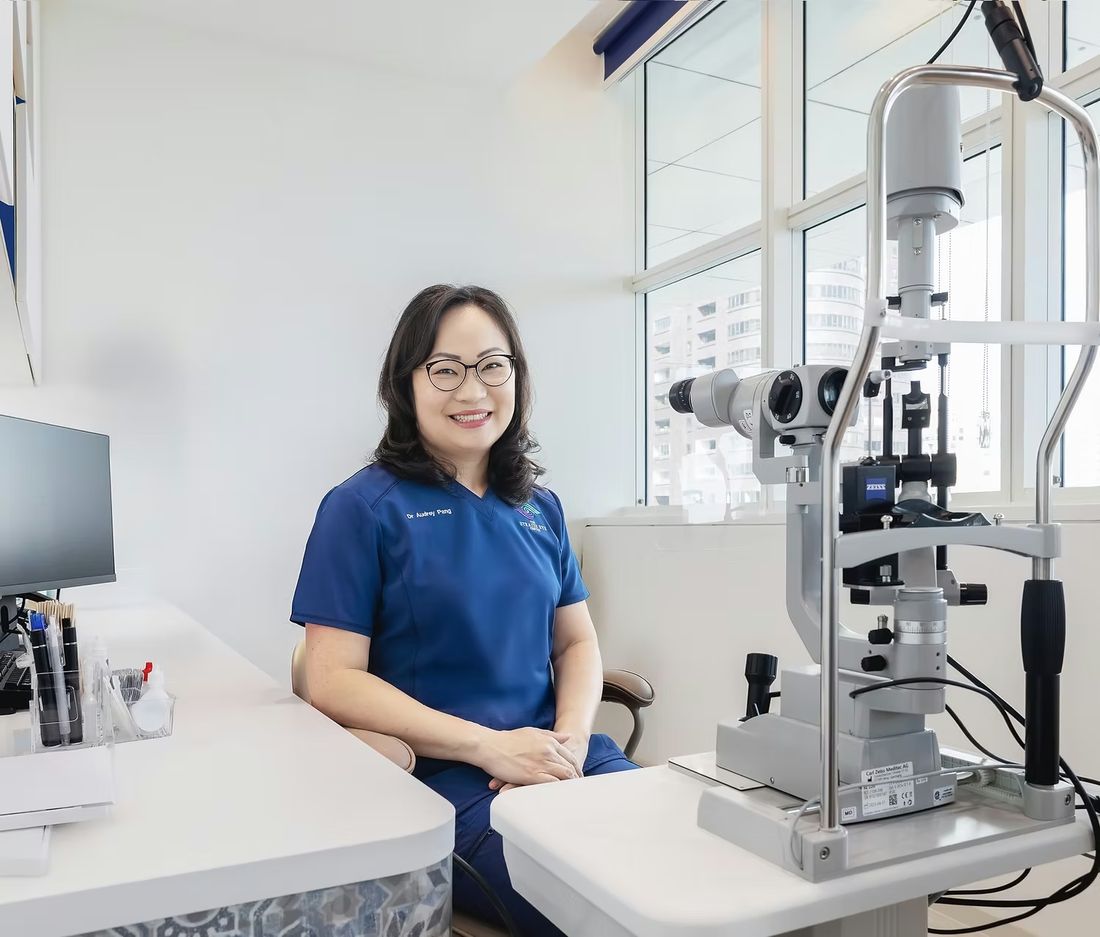
Dr Audrey Pang, Senior Consultant Eye Surgeon, fellowship-trained in paediatric ophthalmology and strabismus. At our community clinics Dr Brendan Chin, Primary Eye Care Physician, also sees children for myopia control.
Measured, then tracked
The prescription and the length of the eye are measured and compared at each visit, because the length is what changes as myopia increases.
Reviewed as your child grows
Myopia control is a series of reviews rather than one visit, and the option can be changed if it is not suiting your child.
Found this helpful?

Short-sightedness in a child is not a fixed prescription. It usually starts in the primary school years and increases while the child grows, which is why glasses are often stronger at each visit. Myopia control aims to slow that increase, so your child ends up with a lower prescription than they otherwise would.
The reason to care about the final number is what sits behind it. As short-sightedness increases the eye grows longer, and the tissues at the back are stretched with it. A longer, more myopic eye carries a higher lifetime risk of conditions affecting the retina. Glasses correct how clearly a child sees today; they do nothing about the length of the eye.
So the goal is a lower prescription at the end of childhood, not thinner lenses along the way. Nothing reverses the short-sightedness a child already has, which is why the useful moment is when the prescription is found to be increasing rather than once it has settled.

Prescription gone up again? Talk to our friendly staff for an appointment with Dr Audrey Pang.
All three slow progression and none stops it. They are alternatives to choose between, not a ladder to climb.
One drop in each eye at bedtime. Atropine is a long-established eye medicine, used here at a far weaker concentration than the drops used to dilate eyes for an examination — which is why it does not usually blur near vision or leave eyes uncomfortable in bright light. It has been studied in children from the age of four. It does not correct vision, so glasses are still worn.
They look like ordinary glasses and are worn like them. The middle of the lens gives clear vision; the area around it is made differently, changing how light focuses in front of the retina. Nothing is asked of the child beyond wearing their glasses, which is why it often suits a younger child or a family that would struggle with drops or lenses.
Ortho-K is a rigid lens worn overnight and taken out in the morning: it reshapes the front surface of the eye while your child sleeps, so the day is spent seeing clearly without glasses. Soft myopia-control contact lenses are worn during the day instead. Both need a child who can handle a lens and keep to the cleaning routine, and both are reviewed regularly, because a contact lens worn poorly is an eye infection risk rather than a convenience.
One drop at bedtime. Glasses are still worn, because the drops do not correct vision.
Worn like ordinary glasses. Nothing extra to remember beyond putting them on.
Overnight or daytime wear. Needs a careful cleaning routine and regular checks.
It is chosen, not ranked, and it can be changed later.
There is no best option in general, and the honest reason is that the one that works is the one a child actually uses every day as directed. What goes into the decision:
It is decided with Dr Audrey at the consultation, after the eyes have been measured, and it is not a one-way door: an option that is not suiting a child can be changed at a review. Children can be seen at our Camden clinic or at Parkway East.
Myopia control is judged on measurements over time, not on how a child says they are getting on. Two numbers are compared at each visit.
Our myopia screening at The Straits Eye Community Clinic in Bedok, Clementi, Toa Payoh and Jurong includes both measurements, at $95.92 nett. It monitors and measures; what to do about a prescription that is increasing is a separate conversation, which is this page.
The treatment depends on which option is used — drops, spectacle lenses and contact lenses are priced differently and are repeat purchases — so it is quoted at your consultation.
| Service | Price |
|---|---|
| Camden & Parkway East | |
| First consultation | $174.40 |
| Follow-up consultation | $119.90 |
| The Straits Eye Community Clinic | |
| Myopia screening | $95.92 |
All fees shown are nett, with GST included. Eye drops, spectacle lenses and contact lenses are charged separately, only where they are needed, and are quoted at your consultation.
Children are seen by Dr Audrey Pang at Camden and Parkway East. For myopia control at our community clinics, Dr Brendan Chin, Primary Eye Care Physician, sees children too — it is one of his clinical interests. Talk to us for a quick appointment.
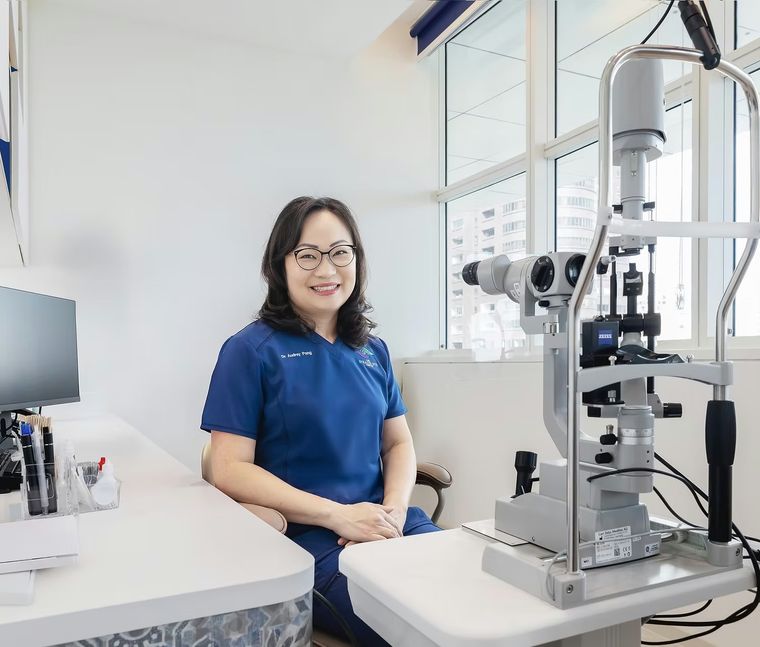
Senior Consultant Eye Surgeon
The Straits Eye Centre
MBBChir (Cambridge) · MMed (Singapore) · FRCOphth (London) · FAMS
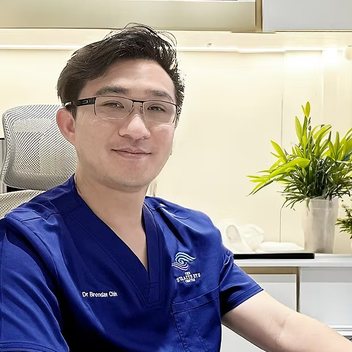
Primary Eye Care Physician
The Straits Eye Community Clinic
MBBS (Singapore) · GDFM (Singapore) · DWD (CAW)
Myopia control is treatment that aims to slow how fast a child’s short-sightedness increases, rather than only correcting it with stronger glasses each year. The three options are low-dose atropine eye drops, myopia-control spectacle lenses, and ortho-K or myopia-control contact lenses. Each can slow progression, though none stops it.
Because the prescription is not the whole story. As short-sightedness increases the eye grows longer, and a longer, more myopic eye carries a higher lifetime risk of conditions affecting the retina. Ending up with a lower prescription is the point, not wearing thinner glasses.
One drop in each eye at bedtime. Atropine is an old eye medicine used at a far weaker concentration for this, and at that strength it does not usually blur near vision or make eyes light-sensitive the way the full-strength drops used for examinations do. It has been studied in children from the age of four.
They look like ordinary glasses and are worn the same way. The centre of the lens corrects the prescription for clear vision, and the area around it is made differently, which changes how light focuses in front of the retina. Your child does not have to do anything differently for them to work.
Orthokeratology, or ortho-K, is a rigid contact lens worn overnight and taken out in the morning. It reshapes the front surface of the eye while your child sleeps, so they see clearly during the day without glasses, and it also slows progression. It needs a child who can handle lenses and keep them scrupulously clean, and the fit is checked regularly.
There is no single answer, and it is chosen rather than ranked. It depends on your child’s age, their current prescription, how fast it is changing, whether they can manage a contact lens, and what the family can keep to every day. The one that works is the one actually used as directed. It is decided at the consultation and can be changed later.
There is no fixed starting age. It is usually begun once a child’s short-sightedness is found to be increasing, often in the early primary school years, and low-dose atropine has been studied in children from four.
Usually once the prescription has stayed stable for some time, often in the mid to late teens, as short-sightedness slows when growth ends. It is decided at a check-up rather than by age alone, because stopping too early can let the increase start again.
They can be used together in some children, for example drops alongside a lens. Whether that applies is a clinical decision made at the consultation and at the reviews that follow.
No. It aims to slow the increase. The prescription your child already has does not go away, which is also why starting earlier in the progression matters more than starting at a particular age.
Time outdoors is associated with less myopia developing in children, so it is worth encouraging, alongside breaks from close work. It is not a substitute for treatment in a child whose prescription is already increasing.
By repeating the measurements and comparing them: the prescription, and the length of the eye, which is what actually changes as myopia increases. Our myopia screening at The Straits Eye Community Clinic includes both, at $95.92 nett.
The treatment itself depends on which option is used, because drops, spectacle lenses and contact lenses are priced differently and are repeat purchases, so it is quoted at the consultation. A first consultation with Dr Audrey Pang is $174.40 nett at our Camden and Parkway East clinics, and the myopia screening at The Straits Eye Community Clinic is $95.92 nett.
Dr Audrey Pang, Senior Consultant Eye Surgeon, whose subspecialty is paediatric ophthalmology and strabismus, at Camden and Parkway East. At our community clinics, Dr Brendan Chin, Primary Eye Care Physician, also sees children for myopia control — it is one of his clinical interests.
Tell us your child’s age and current prescription, and how much it has changed, and we will arrange the right appointment.
Cannot find what you want? Ask our friendly staff instead.