An eye that turns
In, out, up or down, constantly or only when tired.
A squint, or strabismus, is when the two eyes do not point the same way. This page covers what causes it, what glasses and patching can do first, and the operation that straightens the eyes — in children and in adults.
Camden (Orchard)StrabismusChildren & adults
A squint subspecialist
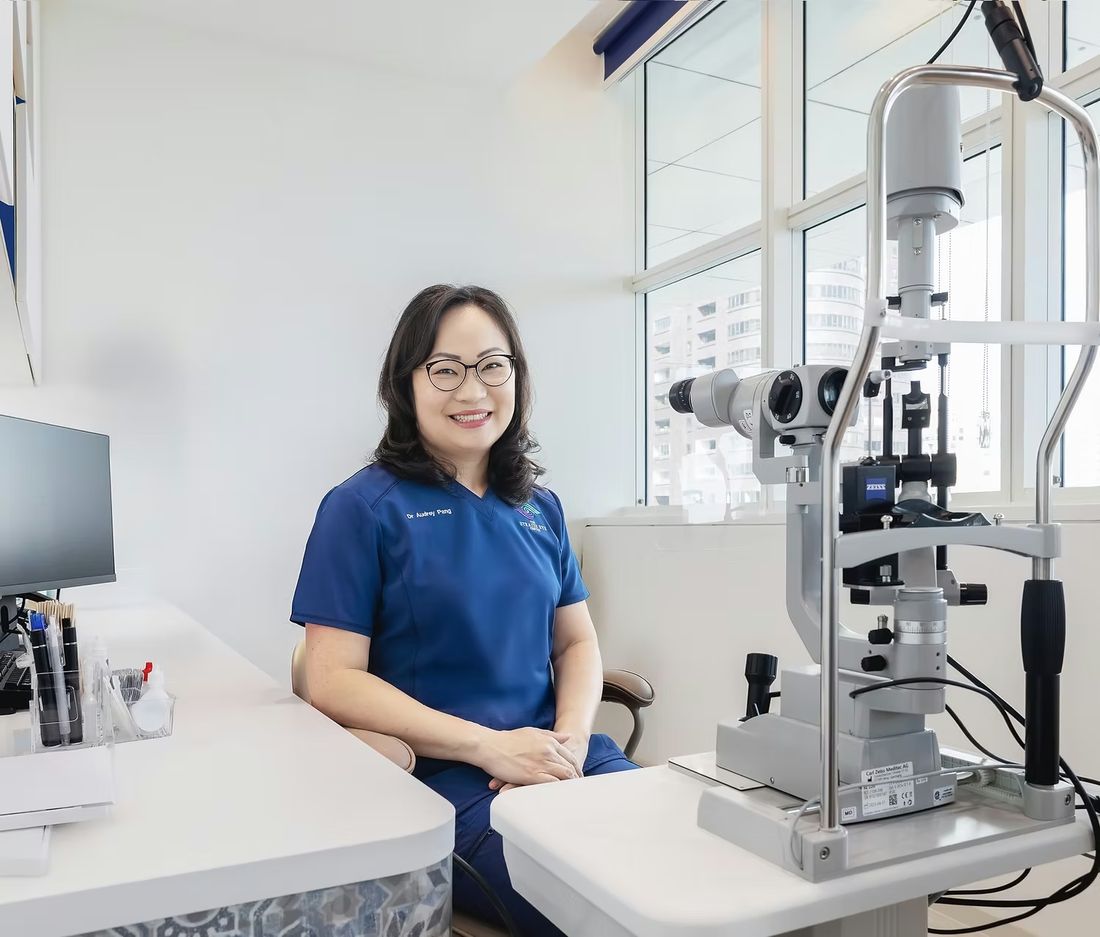
Dr Audrey Pang, Senior Consultant Eye Surgeon, fellowship-trained in paediatric ophthalmology and strabismus at Addenbrooke’s Hospital, Cambridge, and formerly Deputy Head of Paediatric Ophthalmology and Strabismus at Tan Tock Seng Hospital.
The cause is found first
A turn that glasses straighten, one that has led to a lazy eye and one that needs the muscles adjusted are treated differently, so the eyes are measured before anything is decided.
Surgery at Camden
Squint surgery is carried out at our Camden clinic on Orchard Boulevard. Children are also seen at Parkway East, in Joo Chiat.
Found this helpful?

Both eyes normally point at whatever you are looking at, and the brain combines the two pictures into one. In a squint one eye points somewhere else, so the two pictures no longer match.
Aligned eyes: both point at the same thing
A squint: one eye turns away, here inwards
What happens next depends on how old the person is. An adult sees double, because the brain has long since learned to use the two eyes together. A young child usually does not: the developing brain suppresses the picture from the turned eye instead, and that eye can then fail to develop full sight, which is a lazy eye.
So a squint is treated for more than how it looks. It is also the commonest route to a lazy eye, and in an adult it is what makes reading, driving and judging distance difficult.

Noticed an eye turning? Talk to our friendly staff for an appointment with Dr Audrey Pang.
In children it is usually how the eyes have developed, and long-sightedness is a common cause: the effort of focusing pulls one eye inward. It also runs in families. In adults a squint can follow a childhood one that was never fully corrected, or appear with a problem affecting the nerves or muscles that move the eye, after an injury, or with a thyroid eye condition.
In, out, up or down, constantly or only when tired.
Two overlapping pictures, usually in an adult, which can come and go.
A head held to one side, which is how a child avoids seeing double.
Often found at a vision test rather than noticed, because the better eye covers for it.
Which one it is decides the treatment, so the eyes are measured in several directions and at both near and distance.
A pseudo-squint is told from a real one by how light reflects off each eye and by covering one eye at a time, which is part of why a turning eye is worth having measured rather than watched.
Surgery is not the first step for every squint.
Which applies depends on the type of squint, the prescription and how each eye sees, and it is decided with Dr Audrey after the eyes have been measured.
Six small muscles move each eye. A squint operation changes the pull of one or more of them, so the eye comes to rest pointing where the other one does. The eye is never removed from its socket, and nothing is cut on the part of the eye you see through. The muscles are reached through the thin, clear membrane over the white of the eye.
How many muscles are adjusted, and in which eye, follows from the measurements. One eye or both may be operated on in the same sitting.
Decided at the consultation. Children are asleep for it, and the operation commonly takes under an hour.
Fine stitches hold each muscle in its new position and dissolve on their own.
A red, gritty eye for one to two weeks, with drops while it settles. Most children are back at school in about a week.
Squint surgery is carried out by Dr Audrey Pang at our Camden clinic, and only once the eyes have been fully measured. Glasses may still be needed afterwards, because the operation straightens the eyes rather than changing a prescription, and an eye can drift again over the years.
A squint is not only a children’s condition, and being an adult is not a reason it cannot be corrected.
Adults come for three reasons: a turn that has been there since childhood, one that has appeared more recently, and double vision. The operation is the same in principle, and it is often done under local anaesthetic with the person awake.
Dr Audrey Pang operates on adults as well as children. She also performs adult cataract surgery, which is set out on its own page.
The surgery fee depends on how many muscles are adjusted and whether one eye or both are operated on, so it is quoted once the eyes have been examined.
| Service | Price |
|---|---|
| Camden & Parkway East | |
| First consultation | $174.40 |
| Follow-up consultation | $119.90 |
| Squint surgery | Please enquire |
All fees shown are nett, with GST included. The surgery is charged separately, only where it is needed, and is quoted at your consultation. MediSave and Corporate and Personal Insurance can be used towards eligible surgery; we confirm what applies to you when you are seen. Our full price list covers consultations at every clinic.
Squint surgery at The Straits Eye Centre is carried out by Dr Audrey Pang, whose subspecialty is paediatric ophthalmology and strabismus, at our Camden clinic. Talk to us for a quick appointment.
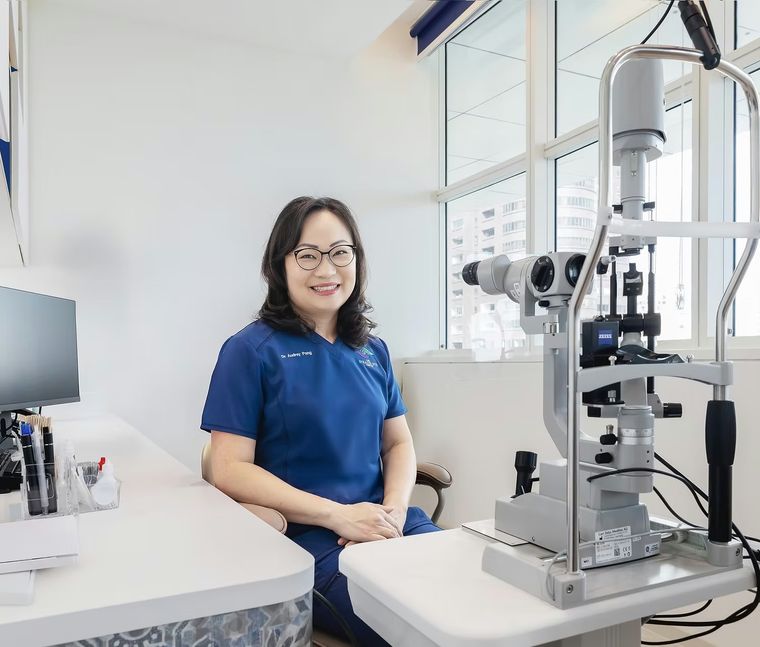
Senior Consultant Eye Surgeon
The Straits Eye Centre
MBBChir (Cambridge) · MMed (Singapore) · FRCOphth (London) · FAMS
A squint, or strabismus, is when the two eyes do not point in the same direction. One may turn in, out, up or down, all the time or only now and then. It is not the same as a lazy eye, though one can lead to the other.
Eyes that wander now and then in the first few months are common and usually settle. An eye that still turns after about four months of age, or one that turns all the time, should be examined, because that kind does not grow out of it.
Many babies have a wide, flat bridge of the nose and a fold of skin at the inner corner of each eye, which hides some of the white on that side and makes the eyes look turned in. This is a pseudo-squint, and the eyes are in fact aligned. It is told apart from a real squint by how light reflects off each eye and by covering one eye at a time, and it becomes less noticeable as the face grows.
Sometimes. A squint caused by long-sightedness often straightens with glasses alone, and where the squint has led to a lazy eye, patching or drops treat the vision. Surgery is for a turn that glasses do not correct, and it is one option among several rather than the first step.
The muscles that move the eye are reached through the thin membrane covering the white of the eye, then loosened, shortened or moved so the eye sits straight. The eye is not removed and nothing is cut on the visible part of the eye. How many muscles are adjusted depends on the direction and size of the turn.
There is no single age. A turn that is there constantly from infancy is often treated early, so the two eyes have the chance to work together while sight develops; one that appears later is treated when it is affecting vision or causing double vision. The decision is made on the type of squint rather than on age alone.
Yes. Adults have squint surgery for a turn that has been there since childhood, for one that has appeared since, and for double vision. Dr Audrey Pang operates on adults as well as children.
Commonly under an hour, depending on how many muscles are adjusted. It is a day procedure, so you go home the same day.
The eye is red and sore for a week or two, and often feels gritty. Eye drops are used while it settles. Most children are back at school within about a week, and the redness fades over several weeks. Avoid swimming and rubbing the eye until you are told it has healed.
It can. An eye can drift again over the years, and some people need more than one operation. Glasses may still be needed afterwards, because surgery straightens the eyes rather than correcting a prescription.
In an adult, often yes, because the brain has learned to use the two eyes together and now receives two different pictures. In a young child it usually does not: the developing brain suppresses the image from the turned eye instead, which is how a lazy eye begins.
The surgery fee depends on how many muscles are adjusted and on whether one eye or both are operated on, so it is quoted once the eyes have been examined. A first consultation with Dr Audrey Pang is $174.40 nett at our Camden and Parkway East clinics. MediSave and Corporate and Personal Insurance can be used towards eligible surgery, and we confirm what applies to you when you are seen.
Dr Audrey Pang, Senior Consultant Eye Surgeon, whose subspecialty is paediatric ophthalmology and strabismus, at our Camden clinic.
Tell us whose eye it is, how long it has turned and whether there is double vision, and we will arrange a time with Dr Audrey.
Cannot find what you want? Ask our friendly staff instead.